Notes from a lake: Plucky
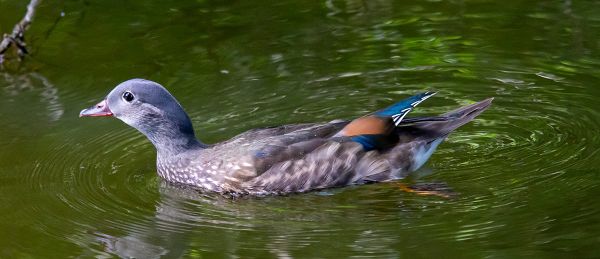
Two weeks ago, I spent a few special moments with a Mandarin Duck family – mum, dad and their single chick. I noticed the male first, of course. His brash oranges, purples, blues and whites. He knows he’s the man with all of his colourful finery. His partner was more demure, soft greys, a polka-dotted belly and white eyeliner round her gentle black eyes.
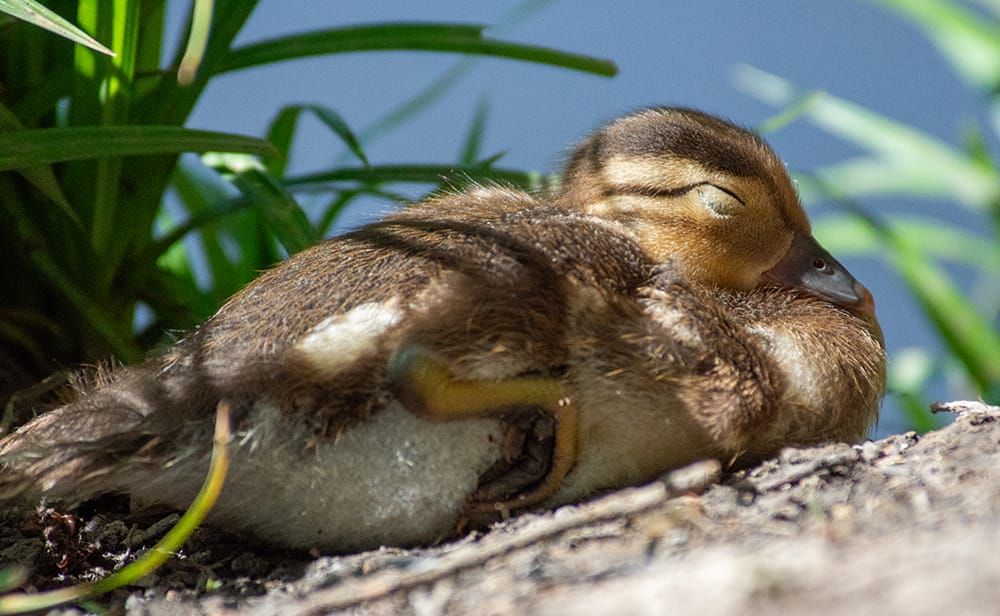
I sat on a bench next to the lake, watching, taking photos. They weren’t far, just at the edge of the lake. He sat amongst the jumble of the alder that had fallen into the lake many years ago and still grows horizontally (nature always finds a way, right?). She sat on a submerged log, resting, between us. Then I saw movement. She had a wee duckling tucked under her abdomen! He came out, watching me as his mum did. She puffed out her chest with such pride. Her little one, so beautiful, so floofy and boopable, and so eager to see the world. I decided to call him Plucky.
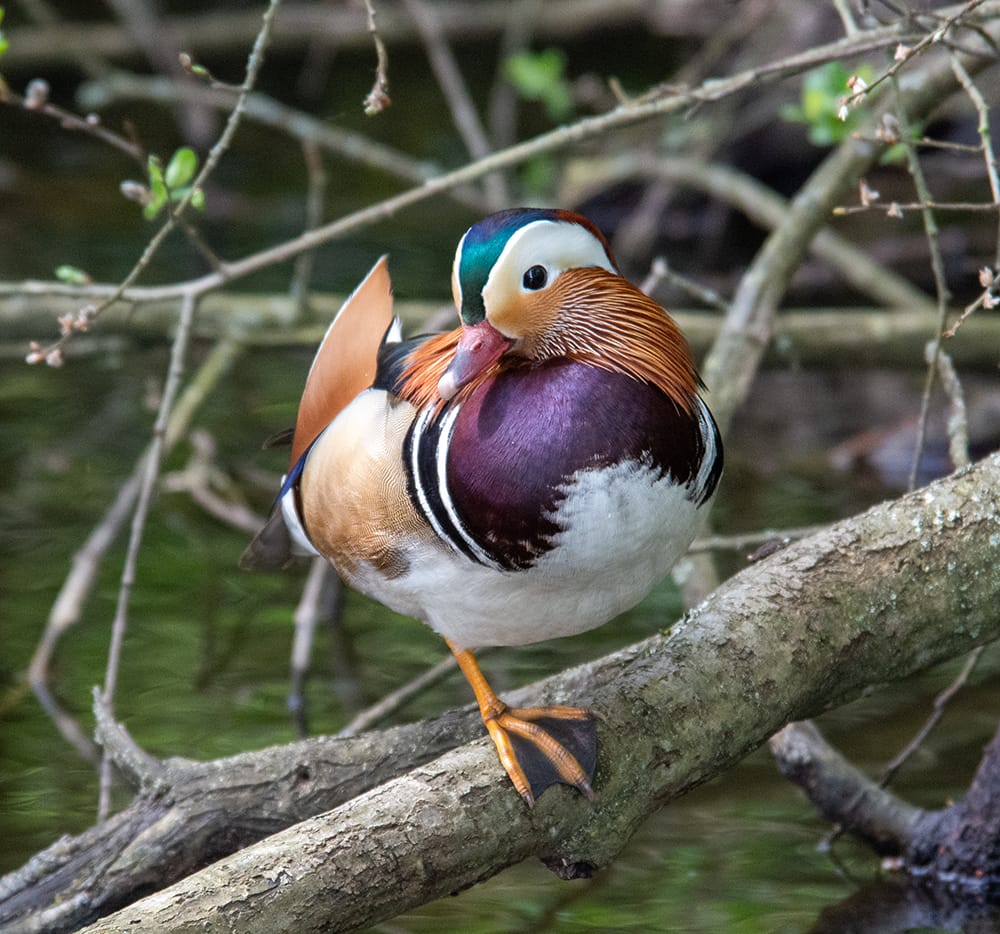
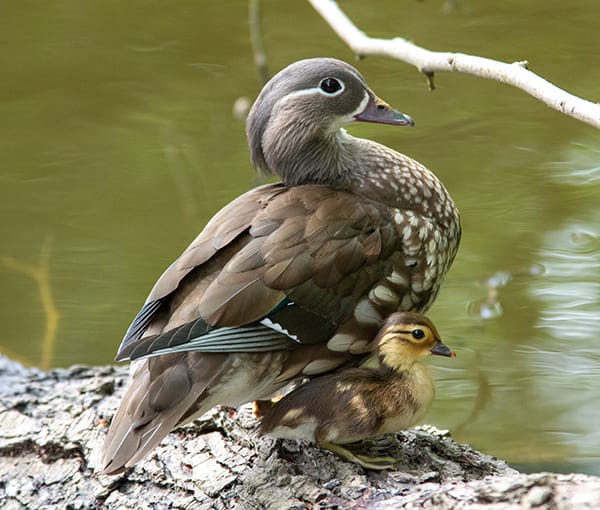
Mandarin ducks are not native to the UK. They originate from East Asia and were originally brought over as ornamentals. Eventually some escaped. By the early 20th century, they were established in the wild in Britain. They prefer lake and riverine habitats, where there is woodland at the edges. This lake is perfect for them – a deep lake surrounded by alder, willow and other trees, with an extensive wet woodlands and small meandering brooks and ephemeral ponds in the back. They nest in trees overhanging the lake.
Once they hatch, the ducklings will jump out of the nest, splashing into the water below. They are also already able to catch their own food – indeed I saw a days-old duckling leap up and catch a damselfly last year, and I’ve never seen a parent feed their young like the Coots or Little Grebes do. They also eat plants, snails, fish. Really anything around the lacustrine habitat. The dad isn’t so great while the mama is brooding. He may be around to defend, but that’s about it. Once the ducklings hatch, it seems to be hit or miss if the dad stays. Plucky’s dad was around til recently, but with the other mandarins, I didn’t see the male at all.
A week later, I saw them again. Mum, dad, and Plucky swimming across the lake. A small, perfectly formed family. They were across the lake, near the wooded wetlands. Another Mandarin family was also out – a female with her eight young.
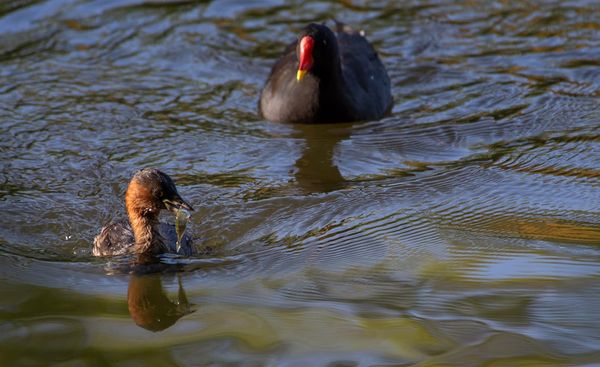
Work and a heatwave then got in the way. Finally, last Wednesday, there was a break – the temperature dropped a few degrees. Phew! I wandered around the lake, taking in the baby Coots, baby Little Grebes, baby Mallards. But no Plucky. Perhaps, they were hiding in the wooded wetlands, I thought.
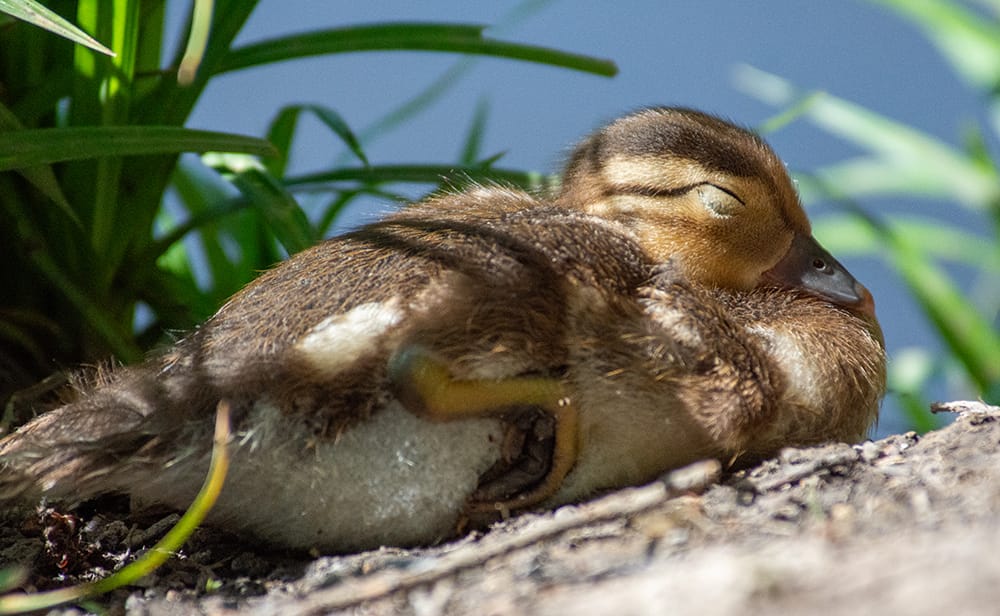
I stopped at one of the banks where I saw some blue damselflies (common and blue tailed) flying about so I decided to photograph them. Then I noticed that I had been joined by someone. It was Plucky! He sat down next to some yellow iris, preened and fell asleep. He was so close I could see him breathe as he slept. He was alone. I looked around for his mum and dad but saw no one. I thought that perhaps they were nearby in the vegetation. Or across the lake. Perhaps Plucky was really plucky. An adventurer looking for damselflies to eat and places to explore. After a few moments, I bade farewell to the little guy and crossed my fingers that his parents were indeed nearby.
I came back today, two days later, but things had taken a turn for the worse. I saw Plucky, swimming, chasing small flying invertebrates. He seemed normal. But he was still alone and he had a horrible wound on his neck. The back of his neck was bare, red and looked so painful. He swam around some more, I watched him, my heart breaking. He went under some vegetation and I left him, hoping that he had eaten enough and could keep himself safe and maybe have the time and peace to heal.
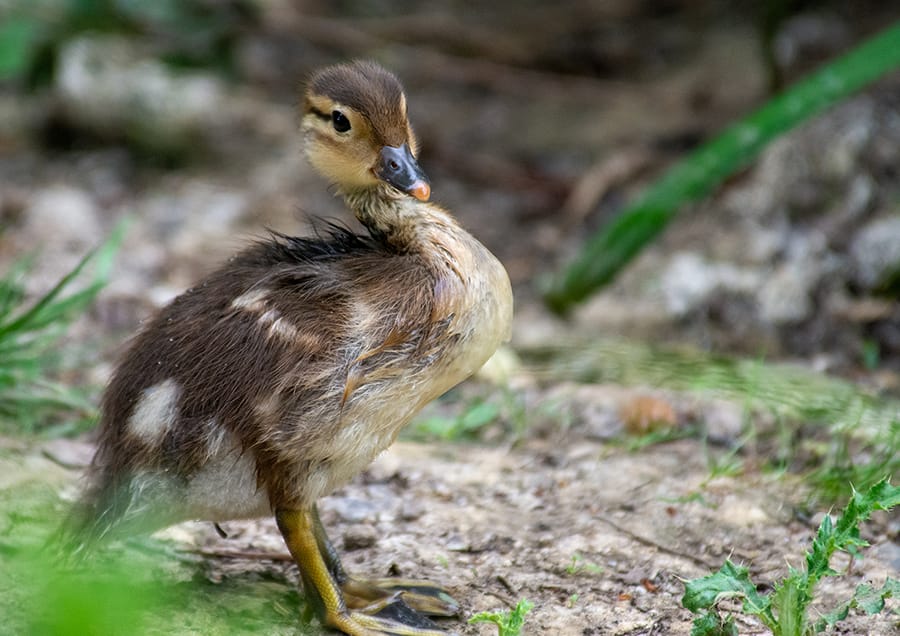
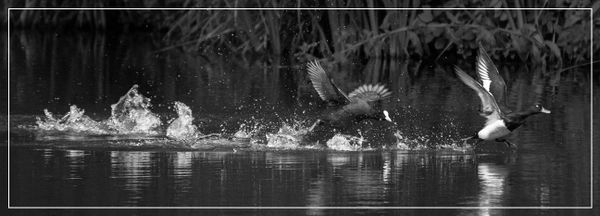
I am not sure what happened. What happened to his parents. What happened to him. It may be that his parents simply abandoned him to try for another, bigger brood. They normally have somewhere between seven to nine little ones, so Plucky’s family was unusually small. Or perhaps they were chased away. A few dog owners are not the most responsible, allowing their dogs run and swim into the water, sometimes chasing the waterfowl. There were signs, asking dog owners to take care and keep their dogs on the lead, but they come down as soon as they are put up. Whatever happened, the parents seem to be gone for now and Plucky was on his own.
As for his wound? My guess is one of the Coots attacked him. There is a Coot brood of eight and a very, very protective mama. I have seem her chase other birds away, and she was also seen attacking a Little Grebe chick (she is OK!). So, maybe Plucky got too close and she warned him off, injuring him in the process.
I went back to the same bank as before. Black-tailed Skimmers were flying about, mating, chasing off rivals, skimming the water, resting on the dried mud of the bank. I took some photos and watched their acrobatics across the water, vegetation and bank. And then, who appeared, but Plucky!
He came onto the bank, walked around a bit, tried to catch one of the skimmers, and finally sat down. I sat down too, close but not too close. This was his bank and he was letting me sit here, with him, even if only for a short time. He slept on, his wee chest going up and down with his deep sleepy breaths. I talked to him, telling him to take care, to hide in the vegetation, to eat and to heal. I took my leave of him after a while. He got up too, and plopped back into the water and into the vegetation lining the side of the lake.
I don’t know what will happen. He likely won’t survive the trauma of this wound, or the predators that lurk, looking for the weak and the injured. But I will be back tomorrow, with a faint hope that Plucky is indeed Lucky.